If you have worked in systems administration for any length of time, you already know that your toolbox keeps changing.
There was a time when that toolbox might have meant command-line utilities, vendor manuals, a notebook full of procedures, and whatever scripts you had written to make repetitive work a little less painful.
Today it may include PowerShell, Bash, virtualization platforms, cloud consoles, monitoring systems, ticketing tools, configuration management, automation, documentation platforms, vendor knowledge bases, and dozens of other technologies.
Now there is another tool that has already arrived in many systems administrators’ boxes:
Artificial intelligence.
And I believe systems administrators should learn how to use it.
But there is an important distinction.
AI belongs in the toolbox. It does not belong in the driver’s seat.
That distinction is at the heart of my upcoming fifth book in The Necessary Evil series:
The Necessary Evil: AI for System Administrators
Systems Administration Is Different
There is no shortage of advice telling people to “use AI to automate your job.”
For systems administrators, that advice can become dangerous very quickly.
Our work lives in real environments.
Real servers.
Real users.
Real business systems.
Real permissions.
Real outages.
Real security boundaries.
Real maintenance windows.
And sometimes very real consequences when something goes wrong.
A generated answer can sound technically impressive and still be inappropriate for your environment.
A command can be syntactically correct and still be the wrong command to run.
A troubleshooting theory can sound perfectly reasonable and still be completely wrong.
A proposed configuration can work technically while violating company policy.
And a change can be a good idea while still being unauthorized.
That is why this book does not begin with the question:
“What can AI do?”
It begins with a more important question:
“What should a systems administrator allow AI to do?”
Think of AI as Another Tool
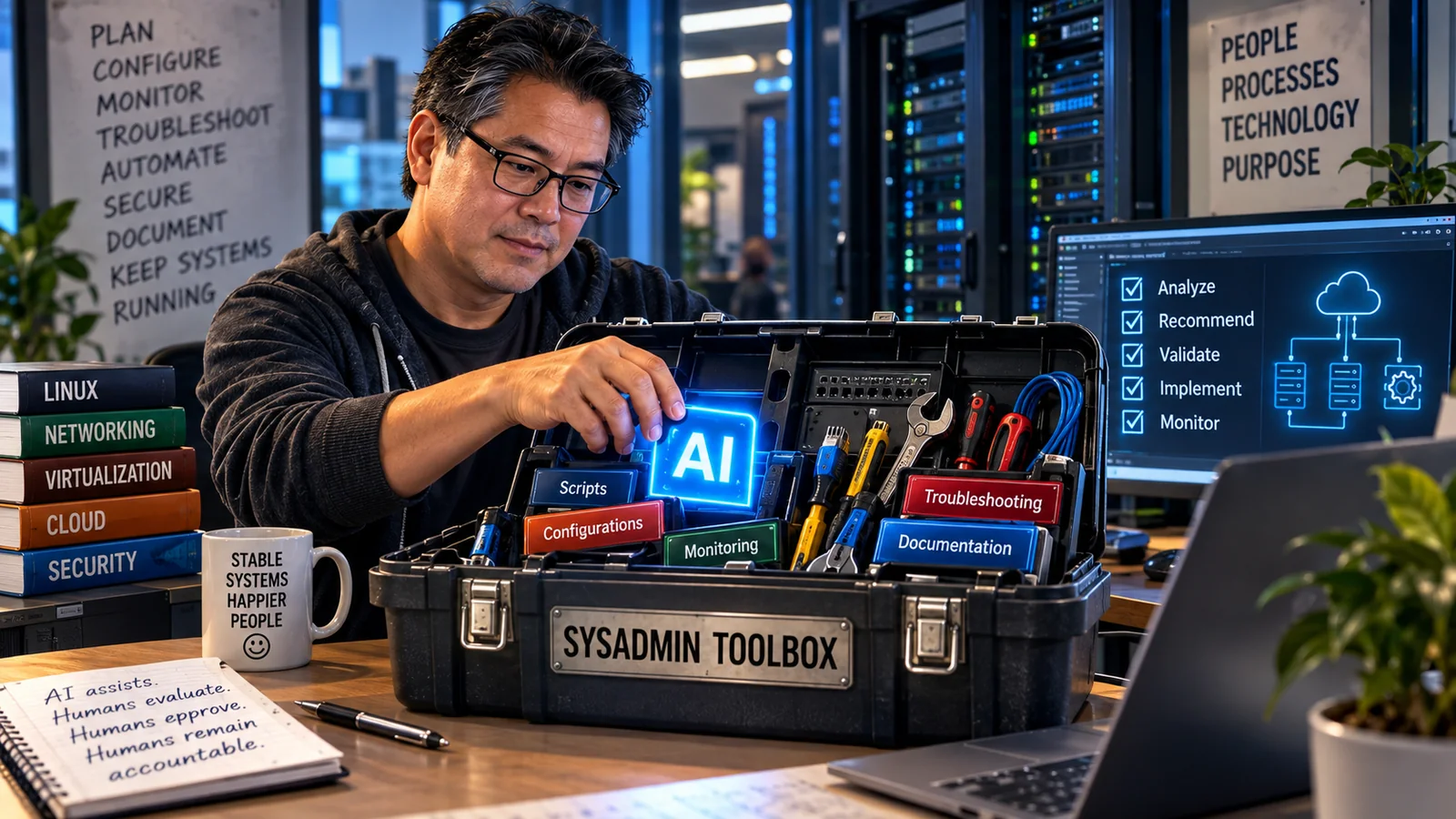
That idea inspired one of the illustrated cover concepts currently being explored for the book: the sysadmin toolbox.
Imagine the tools an administrator already depends on.
Scripts.
Monitoring.
Documentation.
Configuration.
Troubleshooting.
Automation.
Utilities.
Diagnostic tools.
And now, sitting among them, another tool marked:
AI.
That is exactly where I think it belongs.
Not above everything else.
Not replacing everything else.
Not making decisions for the administrator.
One tool among many.
And like every other tool, its usefulness depends on the person using it.
A wrench cannot determine whether a production server should be taken offline.
PowerShell cannot decide whether a change should be approved.
A monitoring platform cannot assume organizational authority simply because it detected an alert.
AI should not be treated differently just because it can communicate in natural language.
Where AI Can Actually Help
Used responsibly, AI can be extremely useful to an administrator.
It can help organize information.
It can help explain an unfamiliar concept before you go to the authoritative documentation.
It can help turn approved technical facts into clearer documentation.
It can compare a sanitized draft against a checklist.
It can help identify assumptions and unanswered questions.
It can help organize troubleshooting evidence.
It can help prepare summaries and communications.
It can assist with planning.
And it can reduce some of the friction surrounding the work that administrators already do.
That is valuable.
But usefulness does not create authority.
The manuscript uses a simple operating principle throughout the book:
AI assists.
Human administrators evaluate.
Authorized humans approve.
Humans remain accountable.
That is not anti-AI.
It is how AI becomes genuinely useful in professional IT.
The Administrator Still Has to Know
One of the risks of generative AI is that it can make an answer look finished before the work actually is.
A polished explanation can create confidence.
A detailed checklist can create confidence.
A beautifully formatted change plan can create confidence.
But systems administration demands something beyond confidence.
It demands evidence.
You still have to know what environment you are working in.
You still have to know what version is actually deployed.
You still have to know which documentation is authoritative.
You still have to know what your organization's policies permit.
You still have to know who owns the system.
You still have to know who can approve the change.
You still have to validate the result.
And sometimes the most important professional decision you can make is to say:
“I don't know yet. I need to verify that.”
AI doesn't eliminate that responsibility.
If anything, AI makes that discipline even more important.
This Isn't a Book About Handing Your Infrastructure to a Chatbot
That is not the book I wanted to write.
I wanted a book for the person who actually has to live with the consequences after the answer leaves the screen.
The administrator staring at a maintenance window.
The person reviewing monitoring data.
The person preparing the change.
The person trying to determine whether the problem is really fixed.
The person documenting what happened.
The person deciding when something needs to be escalated to security, networking, an application owner, management, or another accountable team.
And the person whose name may ultimately be attached to the work.
AI for System Administrators is about fitting AI into that world.
The real one.
A Practical Book for Real Administrators
Throughout the book, the emphasis stays on practical systems-administration work: safely handling information, preparing changes, documentation, troubleshooting, monitoring, validation, recovery thinking, and working within human approval boundaries.
The point isn't to turn a systems administrator into an “AI expert.”
The point is to help a systems administrator become better at recognizing:
Where AI helps.
Where AI stops.
Where verification begins.
And where human responsibility can never be delegated.
That is the kind of AI adoption I believe will matter most in IT.
Not replacing the administrator.
Equipping the administrator.
Something New Is Coming
The manuscript for The Necessary Evil: AI for System Administrators is complete, and the book is moving through its final production work.
An illustrated cover is also being developed and illustrated by my wife Julia, to give this volume its own visual identity while remaining part of the larger Necessary Evil series.
And one idea behind that artwork captures the entire book surprisingly well:
A toolbox filled with the familiar tools of systems administration—with AI sitting among them.
Not the whole toolbox.
Not the person holding the toolbox.
Just another powerful tool that needs to be used well.
That is the book I wanted to write.
And it is coming soon.