Artificial intelligence is no longer something most people encounter only in technology news.
It writes emails. It answers questions. It summarizes documents. Students use it for schoolwork. Employees use it on the job. Businesses are beginning to give AI agents permission to perform tasks rather than simply recommend them. Some people are even turning to AI for companionship.
And the public conversation is changing with it.
In 2026, about half of U.S. adults told Pew Research Center that they had used an AI chatbot. At the same time, 52% said the increased use of AI in daily life made them more concerned than excited, compared with 37% in 2021. Pew Research Center
That combination matters.
AI can be extraordinarily useful.
But usefulness does not eliminate questions about truth, privacy, employment, education, human relationships, responsibility or what role technology should have in human life.
Across The Necessary Evil series, I have returned repeatedly to one principle:
AI should remain a tool that serves human beings—not an authority that replaces human judgment.
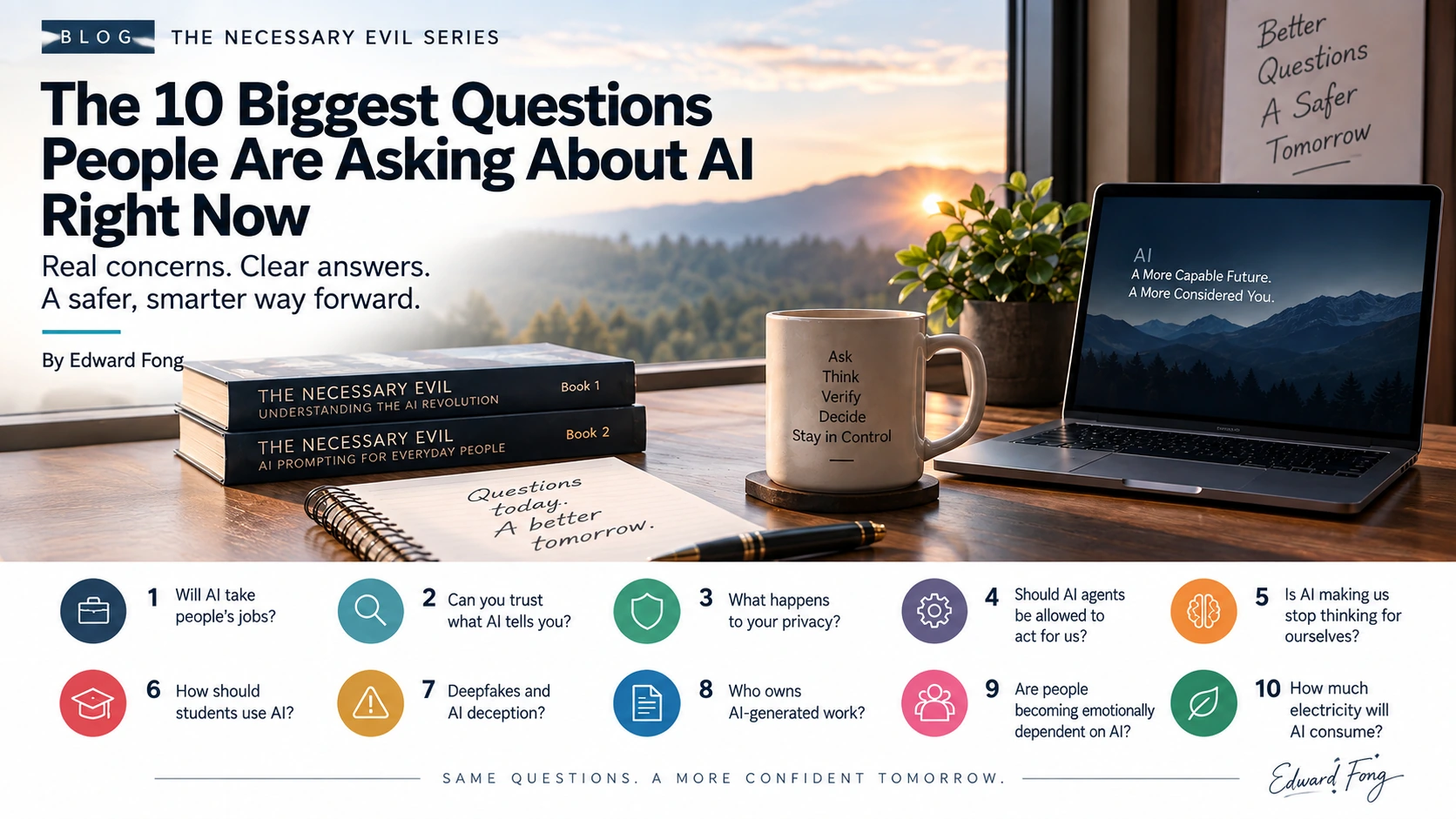
With that in mind, here are ten of the biggest questions worth asking about AI right now.
1. Can You Trust What AI Tells You?
One of AI's greatest strengths is also one of its greatest dangers: it can communicate extremely well.
An answer can be polished, detailed and convincing.
That does not make it true.
Among Americans who do not use AI chatbots, 76% told Pew that lack of trust in their accuracy was at least one reason they stayed away. Pew Research Center
The problem is not that AI is always wrong. It clearly isn't.
The problem is that correct and incorrect answers can sometimes arrive with the same confident tone.
That changes the responsibility of the person using it.
A restaurant recommendation does not require the same verification as medical information. Brainstorming possible vacation activities is different from relying on an AI-generated interpretation of a contract. Asking for a first draft is different from asking AI to establish whether an accusation is true.
The more consequential the claim, the more important verification becomes.
The goal isn't to distrust everything AI says.
It is to stop confusing fluency with evidence.
I explore this question in much greater depth in How Do You Know When an AI Answer Is Wrong?, including how to recognize claims that deserve additional verification.
2. What Information Should You Never Give an AI Chatbot?
People naturally give AI more information when they want better answers.
That makes sense. Context often improves an AI response.
But there is an important difference between useful context and unnecessary exposure.
Privacy is already one of the public's largest concerns about AI. Among Americans who do not use chatbots, 79% told Pew that concern about how their personal information would be used was at least one reason. Pew Research Center
The lesson should not be that you can never tell AI anything personal.
It should be that information deserves classification before disclosure.
Ask yourself:
Does the AI actually need this information to help me?
Passwords, authentication secrets, highly sensitive personal records, confidential business information, information belonging to someone else, and other protected material should not casually become prompt context.
Better prompting isn't simply about giving AI more information.
Sometimes it means knowing what not to give it.
I address that distinction directly in What Information Should You Never Give an AI Chatbot?.
3. Will AI Take My Job—or Change It?
Few AI questions produce more anxiety than employment.
And that concern has increased.
In a June 2026 Pew survey, 71% of U.S. adults said they expected AI to lead to fewer jobs in the United States over the next 20 years, up from 64% in 2024. That is a measurement of public expectation, not a prediction that 71% of jobs will disappear. Pew Research Center
AI will almost certainly change how many kinds of work are performed. Some tasks can already be accelerated or partially automated. New tools will continue changing workflows.
But a job is rarely just one task.
That distinction matters.
The useful career question therefore isn't only:
Can AI perform part of my job?
It is also:
What do I know how to do that remains valuable when the tools change?
Judgment, accountability, domain knowledge, communication, problem solving, verification, relationships, leadership and the ability to direct increasingly capable tools can all matter alongside technical skill.
AI literacy itself is becoming part of that equation.
The future of work deserves more than either panic or promises that everything will remain unchanged.
I've explored that question separately in Will AI Take My Job—or Change It?.
4. How Should Students Use AI Without Letting AI Do the Learning?
This may become one of the defining educational questions of the AI era.
Stanford's 2026 AI Index reports that four out of five U.S. high-school and college students now use AI for schoolwork, while school policies have struggled to keep pace. Stanford HAI
But saying that a student "used AI" tells us very little.
Two students can use the same AI system on the same assignment.
One can finish with a better understanding of the subject.
The other can finish faster while understanding less.
The difference is what the AI was allowed to do.
AI can explain a difficult concept in simpler language. It can create practice questions. It can quiz a student without revealing the answers. It can identify weaknesses in an explanation. It can help organize a study schedule.
Those uses can require the student to remain mentally active.
But AI can also write the assignment, supply answers the student cannot explain, summarize material the student was supposed to read, or eliminate the intellectual struggle that the assignment was designed to develop.
Book 2, The Necessary Evil: AI Prompting for Everyday People, addresses this distinction directly.
The question isn't merely:
Did you use AI?
A better question is:
What did AI do—and what did you still do?
A useful learning tool should strengthen the learner rather than make learning unnecessary.
5. Is AI Helping Us Think—or Making It Easier Not to Think?
The student question belongs to a much larger issue.
AI can remove enormous amounts of cognitive friction.
Sometimes that is exactly what we want.
Nobody needs to prove human dignity by manually reformatting a spreadsheet for three hours when a tool can do it in seconds.
But there is another kind of friction that matters.
Writing forces us to organize ideas.
Working through a problem can expose what we don't understand.
Research forces us to compare claims.
Conversation forces us to encounter another human perspective.
Decision-making forces us to accept responsibility.
If AI repeatedly performs those activities instead of assisting us with them, convenience can become dependence.
That is why the proper measure of AI isn't simply how much work it can remove.
We should also ask:
What human capacity was this work exercising?
I've examined that problem more fully in Is AI Making Us Forget How to Think?.
The goal is not to preserve inefficient work for its own sake.
It is to make sure that when AI removes effort, it does not quietly remove the thinking we actually needed to do.
6. How Much Autonomy Should an AI Agent Have?
For years, most everyday AI interaction followed a simple pattern:
You asked.
AI answered.
That boundary is changing.
AI agents can increasingly interact with tools and systems and take actions rather than merely generate text.
That introduces a different question.
It is no longer only:
What can AI tell me?
It becomes:
What am I willing to authorize AI to do?
Interestingly, this concern is now being acknowledged even by organizations that advocate expanded technological adoption.
A 2026 World Economic Forum report developed with Capgemini says organizations deploying AI agents face challenges defining and enforcing what those agents are authorized to do. It specifically discusses systemic vulnerabilities, authorization, monitoring, auditability and human accountability. World Economic Forum report
I cite that report carefully.
In Book 1, The Necessary Evil: AI, Dehumanization, and the Fight for Human Dignity in a Transhumanist Age, I warned about broader technological ideologies promoted through institutions including the World Economic Forum. Citing one WEF report here does not mean endorsing that broader philosophy.
Rather, the acknowledgment is significant precisely because an institution advocating technological adoption is itself recognizing that greater AI autonomy creates governance and accountability problems.
The Necessary Evil position goes further than asking whether autonomy can be technically controlled.
We should also ask:
What authority should never have been delegated in the first place?
An AI system may be able to execute a decision.
That does not mean it can own responsibility for the consequences.
Related reading: How Much Autonomy Should an AI Agent Have?
7. Can AI Replace Human Relationships?
AI can simulate remarkably convincing conversation.
That makes it useful for communication practice, brainstorming, explanation and many other tasks.
It also creates a temptation to treat simulated relationship as relationship itself.
The distinction matters.
An AI system can produce words that sound empathetic without experiencing empathy. It can generate affectionate language without loving someone. It can respond at 2 a.m. without possessing friendship, sacrifice, loyalty or moral obligation.
Recent public concern illustrates the issue. In a June 2026 Pew survey, Americans were more likely to say chatbots hurt rather than help people who use them for support with loneliness or depression, although substantial shares were uncertain about their effects. Pew Research Center
That survey does not prove that every form of AI companionship is harmful.
But it demonstrates that the question has moved beyond science fiction.
Book 1 approaches this from the standpoint of human dignity.
Human beings should not gradually redefine relationship downward until a sufficiently persuasive simulation counts as the real thing.
AI can assist human communication.
It cannot become the human being on the other side of the relationship.
Related reading: Can an AI Companion Actually Love You?
8. Who Owns Something Created With AI?
AI has made creation easier.
It can help draft writing, generate images, suggest music, produce code, brainstorm designs and transform rough ideas into polished material.
But that raises an increasingly important question:
When AI participates in creation, what exactly belongs to the human creator?
The U.S. Copyright Office has been examining this issue in a multipart AI initiative covering digital replicas, copyrightability and generative-AI training. U.S. Copyright Office
Its copyrightability report concluded that generative-AI outputs can receive copyright protection where a human author has determined sufficient expressive elements. Human-created arrangements or modifications may qualify, while merely providing prompts does not by itself establish copyrightability. AI assistance also does not automatically prevent a larger human-created work from receiving protection. U.S. Copyright Office report announcement
The law will continue encountering new situations, and anyone facing a consequential copyright question should consult current authoritative guidance or qualified counsel.
But there is a broader human question underneath the legal one.
What did you create?
What did you direct?
What did you select?
What did you substantially transform?
And what did the machine generate for you?
As AI becomes increasingly involved in creative work, maintaining that distinction may become more important rather than less.
9. How Much Energy Should AI Consume?
AI feels almost weightless when we use it.
Type a question.
Receive an answer.
But the computation happens somewhere.
The International Energy Agency reports that electricity consumption from AI-focused data centers increased 50% in 2025. It also emphasizes an important distinction: efficiency per AI task is improving rapidly, but newer applications—including reasoning, video generation and agentic tasks—can require hundreds or even thousands of times more energy per query than simple text generation. International Energy Agency
That means simplistic claims in either direction can mislead.
A basic text query is not environmentally equivalent to every other AI workload.
At the same time, enormous growth in AI use and more computationally demanding applications can create significant infrastructure and electricity demands.
The practical question therefore isn't:
Is every AI query bad for the environment?
Nor is it:
Does efficiency mean AI's energy use no longer matters?
The better question is whether the value produced justifies the resources being consumed—and how technology companies, infrastructure providers and users respond as AI usage scales.
AI is not immaterial simply because its infrastructure is invisible to the person typing the prompt.
10. If AI Keeps Getting More Capable, Could It Eventually Become a Mind of Its Own?
This question sits underneath many others.
People often use words such as intelligence, autonomy, agency and consciousness as though they mean the same thing.
They do not.
A system can become better at solving problems without becoming conscious.
It can be authorized to take more actions without becoming morally responsible for those actions.
It can produce increasingly humanlike language without establishing that there is a humanlike inner life behind those words.
And a system can appear independent while still operating through human-designed models, infrastructure, permissions, objectives and access.
That distinction matters because exaggerated assumptions can push the conversation in opposite directions.
One side may treat AI as though it is already becoming a new form of person.
Another may assume that because AI isn't human, increasing capability presents no serious risks.
Neither conclusion follows automatically.
AI can become extraordinarily powerful without becoming human.
And powerful tools still require boundaries.
In Intelligence, Autonomy and Consciousness Are Not the Same Thing, I examine those distinctions more closely.
Book 1 takes the larger question further.
The deepest issue may not ultimately be whether machines become sufficiently humanlike.
It may be whether human beings begin changing their understanding of themselves to accommodate the machines.
That is where questions about AI intersect with questions about human dignity, transhumanism and the technological vision of the human future.
The Question Behind All Ten Questions
These ten questions appear different.
Accuracy.
Privacy.
Jobs.
Education.
Thinking.
Autonomy.
Relationships.
Creativity.
Energy.
Consciousness.
But there is a thread running through all of them:
What belongs to the tool, and what must remain human?
That is one of the central questions behind The Necessary Evil series.
I am not interested in teaching people to fear AI.
I use AI.
I believe it can be extraordinarily useful.
It can help ordinary people write, learn, organize, research, create, troubleshoot, plan and perform work that previously required far more time.
But the more useful AI becomes, the more important it becomes to understand its proper place.
AI can assist without becoming the authority.
AI can generate without determining what is true.
AI can recommend without owning the decision.
AI can automate without owning responsibility.
AI can simulate conversation without becoming a human relationship.
AI can become more capable without becoming the measure of what a human being is.
That is why the goal should not simply be to become better at using AI.
The goal should be to become better at remaining human while using it.
Practical Takeaway
The next time you use AI, don't only ask:
What can this tool do for me?
Add three more questions:
What am I still responsible for?
What should I verify before I trust or act on this?
What part of this should remain human?
Those questions apply whether you're writing an email, studying for an exam, researching a purchase, automating a business process, creating something new or experimenting with the latest AI agent.
The technology will keep changing.
Human responsibility should not disappear with each new capability.
Continue the Conversation
The Necessary Evil series examines these questions from different directions.
The Necessary Evil: AI, Dehumanization, and the Fight for Human Dignity in a Transhumanist Age examines the larger struggle over human dignity, technological power and what happens when tools begin reshaping our understanding of the human person.
The Necessary Evil: AI Prompting for Everyday People moves from warning to practice: how ordinary people can direct AI, provide useful context, protect appropriate boundaries, review its work, verify what matters and remain responsible for the final result.
The Necessary Evil: AI for Everyday Christian Life examines where AI can assist Christians—and where technology must never replace Scripture, prayer, relationship with God, relationship with Jesus Christ, Christian community or the truth of what Christ accomplished through His blood and on the cross.
The Necessary Evil: AI Orchestration for Real Work addresses the next stage: using multiple AI tools, workflows and agents while maintaining meaningful human authority and approval.
Different books.
Different applications.
The same underlying principle:
Use the technology. Do not surrender the human role to it.