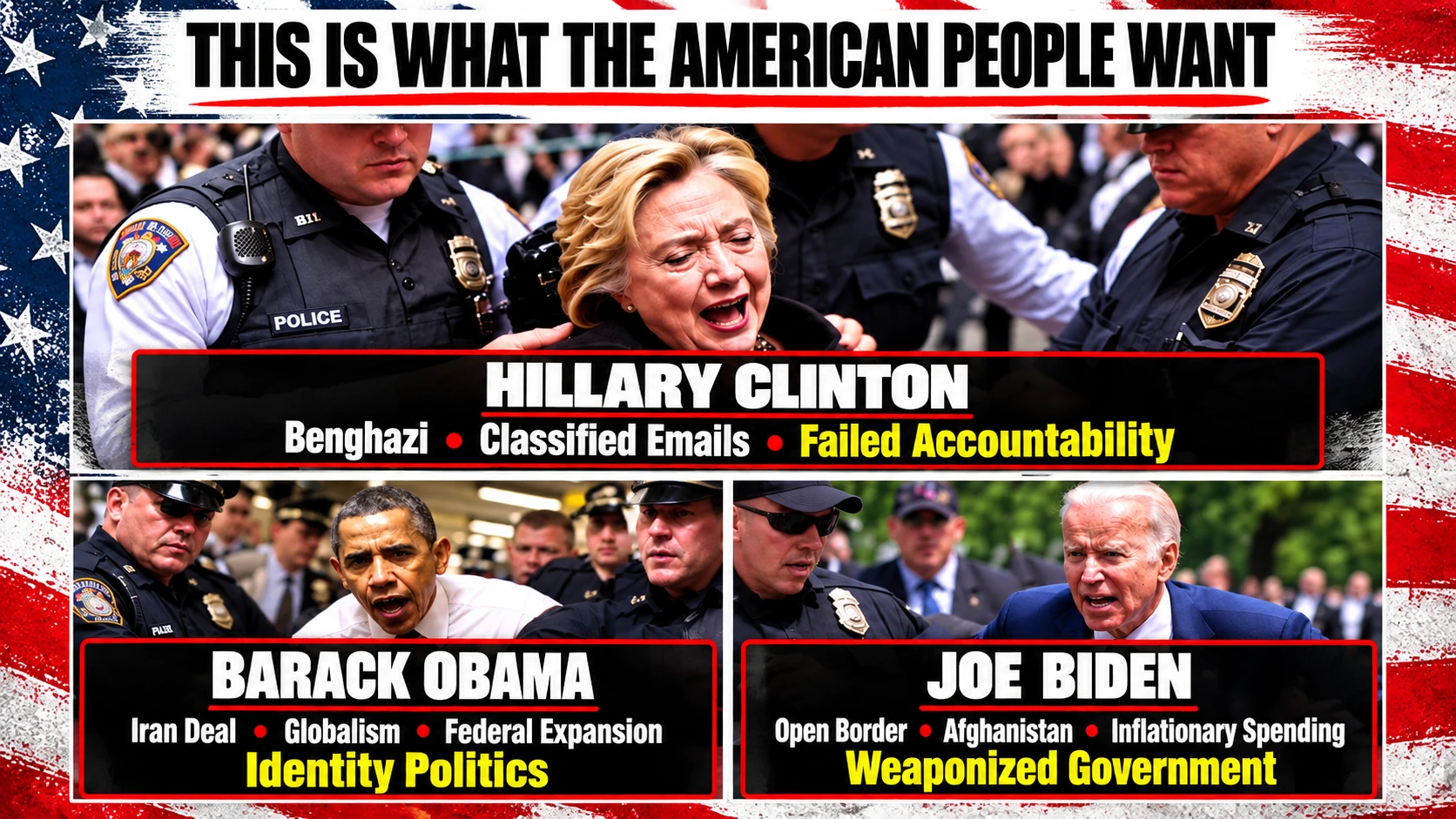
There comes a point when complaining about what is happening in this country is not enough.
You can be angry about the border. You can be angry about Afghanistan. You can be angry about government spending, federal overreach, the use of government power, Benghazi, classified information, foreign policy, trade, energy, or what you believe Washington has done to this country.
But eventually there is a question every American has to answer:
What are you going to do about it?
The image above is provocative. It is supposed to be. But this article isn't about proving a meme right. The image reflects frustration over events and controversies that actually happened. The important question is what the documentary record says about them.
And that distinction matters.
Bad policy is not automatically a crime. An allegation is not a conviction. An investigation is not proof of guilt. Political disagreement is not evidence of criminal conduct.
At the same time, holding public office should not place anyone beyond scrutiny.
I believe Americans have watched serious failures of government, failures of accountability and—in some cases—conduct that deserves continued investigation. I also believe many policies now being pursued by President Donald Trump are moving this country in a better direction.
You don't have to take my word for any of it.
Look at the record.
Start With the Border
Consider the southern border.
Whatever political language people want to use to describe what happened during the Biden administration, the numbers themselves are extraordinary.
A Department of Homeland Security Office of Inspector General report recorded 2,473,134 Southwest border encounters during fiscal year 2023. That wasn't a number invented by a Republican campaign ad. It came from the government's own records.
Then something important happened.
In June 2024, the Biden administration imposed additional restrictions on asylum eligibility and increased consequences for people crossing illegally. By September, DHS Secretary Alejandro Mayorkas said illegal crossings at the southern border had dropped by more than 55 percent following those actions. DHS statement
Think about what that tells us.
Stronger enforcement produced a measurable change.
That is one reason I reject the idea that the country simply had to accept the earlier situation as unavoidable.
I support stronger border enforcement. I support enforcing immigration law. I support knowing who is entering this country. And I support a government that treats control of its own border as one of its fundamental responsibilities.
People can disagree with me about those policies.
But they shouldn't pretend the consequences of policy choices aren't measurable.
This Was Bigger Than One Policy
My disagreement with the Obama and Biden years isn't based on one event.
I believe they represented a broader governing philosophy: greater federal authority, greater regulation, enormous federal spending, international agreements and institutions playing larger roles in American policy, and an approach to sovereignty very different from the America First philosophy I support.
Consider the Iran nuclear agreement. Consider the Paris climate agreement. Consider the growth of federal regulatory policy. Consider immigration enforcement. Consider spending. Consider the increasing role of identity politics in American public life.
Supporters of those policies have their arguments for them.
I disagree with many of those arguments.
I don't believe America's government should be embarrassed to put American citizens, American workers, American security and American sovereignty first.
That is one of the fundamental reasons I support many of Trump's policies.
What Happened to the Promise of Racial Unity?
When Barack Obama was elected in 2008, there was enormous optimism about what America's first Black president might mean for race relations.
Pew Research Center found that 52 percent of voters expected Obama's election to improve race relations, while only 9 percent expected them to get worse. Among Black voters, the optimism was even greater: roughly three-quarters expected improvement. Pew Research Center
That was an extraordinary moment.
But compare those expectations with what Americans were saying near the end of Obama's presidency.
In 2016, Pew found only 19 percent of Americans saying race relations were improving. Thirty-eight percent said they were getting worse. Twenty-five percent said Obama had made race relations worse, while 34 percent said he had made progress and 28 percent said he had tried but failed. Pew Research Center
There is an important fact here that I don't want to hide simply because it complicates the picture.
Black Americans evaluated Obama considerably more positively. Fifty-one percent of Black respondents said he had made progress on race relations, while another 34 percent said he had tried but failed. Only 5 percent said he had made them worse. Pew Research Center
Those numbers matter too.
But so does the larger trajectory.
America went from tremendous optimism about racial reconciliation to the Ferguson unrest, Baltimore unrest, the rise of Black Lives Matter, bitter arguments about policing, increasingly racialized political discourse and a country still deeply divided over race.
I also personally encounter Black Americans—in conversations, commentary and online—who strongly criticize Obama and reject the idea that electing America's first Black president translated into the improvements they expected in their communities.
That's my observation, not national polling, and I won't pretend otherwise.
But it reinforces something I think is worth remembering:
Symbolism is not the same thing as results.
Afghanistan Wasn't Just a Political Talking Point
Then there is Afghanistan.
I consider the withdrawal one of the clearest examples of government decision-making with enormous real-world consequences.
But let's describe what actually happened rather than exaggerate it.
The United States did not simply hand the Taliban a $7.1 billion check for weapons.
SIGAR reported that approximately $7.1 billion in U.S.-funded defense articles and equipment previously provided to the Afghan government remained in Afghanistan when the Taliban took control. U.S. forces rendered some equipment inoperable during the evacuation, including aircraft and armored vehicles. SIGAR evaluation
That's the accurate version.
And I find it disturbing enough without embellishment.
There is another part of the record that deserves at least as much attention.
SIGAR later testified that Afghan security forces depended heavily on American contractors to maintain equipment, operate supply chains and support their forces. SIGAR concluded that the abrupt withdrawal of contractor support was a significant contributor to the collapse of the Afghan National Defense and Security Forces. SIGAR testimony
That's not hindsight from a political meme.
That's an inspector general explaining what happened.
People can debate the wisdom of leaving Afghanistan. They can debate the decisions made across multiple administrations during twenty years of war.
My criticism is about how the final withdrawal was handled.
When government decisions involve American lives, billions of dollars of American-funded equipment and national security, accountability shouldn't disappear because admitting failure would be politically inconvenient.
Benghazi: Responsibility and Accountability Are Not the Same Question
Four Americans were killed in the September 2012 terrorist attack in Benghazi:
Ambassador Christopher Stevens. Sean Smith. Glen Doherty. Tyrone Woods.
Their names should not disappear behind political slogans.
The State Department's own Accountability Review Board found that the security posture at the Benghazi Special Mission compound was inadequate for the threat environment and grossly inadequate for the attack that occurred. It identified serious failures in how security responsibilities were handled. State Department
The board also made something else clear: responsibility for the deaths ultimately rested with the terrorists who carried out the attack. State Department
Those two facts are not contradictory.
Terrorists were responsible for murdering Americans.
And Americans are still entitled to ask whether their government adequately protected its people and whether leadership was held accountable when it failed.
Hillary Clinton was Secretary of State.
In my view, leadership means accepting responsibility not only for an organization's successes but also for serious failures occurring under your authority.
Congress subsequently conducted an extensive investigation of the attack, producing the House Select Committee's final report. Readers don't have to rely on somebody's summary of it; the complete congressional report remains available through the Government Publishing Office. GovInfo report
That is the kind of record I want people to examine for themselves.
Then There Were the Emails
The Clinton private-email investigation provides another example of why facts and accountability need to be separated from slogans.
FBI Director James Comey said investigators found evidence that Clinton and her colleagues had been “extremely careless” in handling very sensitive, highly classified information.
The FBI found email chains concerning information classified at the Top Secret/Special Access Program level. FBI statement
But there is another fact that belongs in the same paragraph:
The FBI said it did not find clear evidence that Clinton or her colleagues intended to violate the laws governing classified information, and Comey ultimately recommended against prosecution. FBI statement
So no, Hillary Clinton was not convicted over the email investigation.
I don't need to pretend she was.
I can acknowledge the FBI's decision and still believe that the conduct it documented deserved greater accountability.
That's the difference between evidence and political mythology.
And Now We Have Arctic Frost
Some of the most important accountability questions are not decades old.
They are developing right now.
The Senate Judiciary Committee has released extensive materials concerning Arctic Frost, the FBI investigation that became part of the foundation for Special Counsel Jack Smith's investigation involving Donald Trump and the 2020 election.
According to Senate Judiciary Committee materials, the investigation generated records concerning at least 430 Republican individuals and entities. Chairman Chuck Grassley has also released material concerning congressional communications, financial information and records involving journalists. Senate Judiciary Committee
In July 2026, Grassley's committee said Smith's investigative team obtained and reviewed text messages involving 44 members of Congress. Senate Judiciary Committee
This is exactly where careful language matters.
Those records do not, by themselves, establish that Joe Biden personally ordered illegal surveillance.
They don't prove Barack Obama committed a crime.
They don't automatically establish criminal intent by everyone involved.
And Senator Grassley's conclusions about what the documents demonstrate are his conclusions as the committee chairman. A Senate press release doesn't magically turn political interpretation into an adjudicated fact.
But neither should those qualifications be used as an excuse to ignore what has been uncovered.
I find the breadth of the investigation deeply concerning.
And my standard is straightforward:
If federal investigative powers were knowingly abused against political opponents, members of Congress, journalists or ordinary Americans without lawful justification, investigate it completely.
And if evidence establishes criminal conduct, prosecute whoever committed it.
Nobody Is Above the Law
That brings me directly to the arrest imagery.
Yes, I personally believe some of what Americans have witnessed deserves serious criminal investigation.
I'm talking about potential abuses of government power, corruption where evidence supports it, unlawful surveillance where evidence supports it, obstruction where evidence supports it, mishandling classified information, national-security misconduct and other possible violations of law.
But notice what I keep saying:
Where the evidence supports it.
A meme doesn't convict anyone.
Neither does a congressional hearing.
Neither does a political speech.
Neither does a Facebook post.
Evidence does.
And if evidence establishes a crime, I don't care whether the person involved is a former president, former secretary of state, attorney general, FBI official, prosecutor, member of Congress, Republican, Democrat or anybody else.
Investigate it.
Prove it.
And if a crime is established under the law, prosecute it.
Political affiliation should not subject someone to prosecution without evidence.
But political affiliation shouldn't protect someone from prosecution when the evidence is there either.
Nobody is above the law.
Now Look at the Direction We're Going
This is where my political position becomes very clear.
I support many of the policies President Trump is implementing.
Not because Donald Trump is incapable of being wrong.
Not because every Republican policy is automatically good.
And not because I think political parties deserve blind loyalty.
I support policies that I believe put America in a stronger position.
I support stronger border enforcement.
I support domestic energy production.
I support reducing unnecessary federal regulation.
I support rebuilding American manufacturing.
I support stronger customs enforcement.
I support confronting trade practices that hurt American workers and strategic industries.
I support strengthening supply chains instead of making the United States unnecessarily dependent upon foreign countries for things essential to our economy and national security.
The current administration has moved aggressively on customs enforcement. A June 2026 executive order directed stronger importer vetting, additional disclosure requirements, increased audits and enforcement against misclassification, undervaluation and illegal transshipment. White House
The administration has also continued using tariffs in strategic industries including steel, aluminum and copper. White House
People can—and do—argue about the economic effects of tariffs.
That's a legitimate debate.
My position is that trade policy shouldn't be evaluated solely according to whether imported goods are a little cheaper next month. Manufacturing capacity, national security, supply-chain resilience and whether America can produce critical goods for itself matter too.
Energy is another example.
The U.S. Energy Information Administration currently forecasts American crude-oil production averaging a record 13.8 million barrels per day in 2026, exceeding the previous record of 13.7 million barrels per day in 2025. EIA
I'm not going to pretend a president personally produces every barrel of oil.
Oil production responds to investment decisions, geology, prices, infrastructure, technology and policy over many years.
But I support a federal policy environment that encourages America to produce more of its own energy rather than treating domestic production as something to apologize for.
These are policy choices.
And policy choices have consequences.
This Is Why Elections Matter
I know where I stand.
I intend to vote for candidates who support the policies I believe are working: securing the border, putting American interests first, expanding domestic energy, reducing unnecessary federal regulation, strengthening American industry, protecting our supply chains and demanding accountability when government power is abused.
That's my vote.
Your vote belongs to you.
Don't vote because a celebrity tells you to.
Don't vote because I tell you to.
Don't vote because a meme makes you angry.
Read.
Investigate.
Look at what your government actually did.
Look at what candidates actually support.
Check the sources.
Challenge claims you think are wrong—including mine.
And then decide what direction you believe this country should go.
But if you've spent years saying you're tired of what is happening to America and then decide that voting isn't worth your time, ask yourself a simple question:
How do you expect anything to change if you voluntarily surrender your voice?
Elections have consequences.
We have watched those consequences unfold in both directions.
Your vote is one of the few moments when nobody in Washington gets to cast your ballot for you.
Use it.
Don't let your voice go unheard.
Vote.
Practical Takeaway
Don't base your vote on one meme, one politician, one television network, one social-media post—or this article.
Pick the issues that matter most to you. Examine the records behind them. Distinguish documented facts from allegations and political interpretations. Decide which policies and candidates most closely represent the direction you want the country to take.
Then participate.
Because elections have consequences—and choosing not to vote is still a choice about who gets to make those decisions without your voice.
Related reading
Explore The Necessary Evil series
Read Edward Fong's work on human responsibility, judgment, technology, faith, and accountability.
Find Your Book